
Building Information Modeling (BIM) has transformed the construction industry by replacing traditional 2D drafting with a collaborative, data‑driven, 3D modeling process. Instead of working in isolated silos, architects, engineers, contractors, and facility managers now share a unified digital model that represents a building’s physical and functional characteristics throughout its entire lifecycle.
BIM isn’t just a software tool — it’s a smarter, more coordinated approach to planning, designing, constructing, and managing buildings.
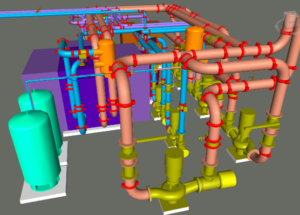
Key Characteristics of BIM
Intelligent, Data‑Rich 3D Models
BIM models contain far more than geometry. They include:
- Spatial relationships
- Material properties
- Equipment data
- Quantities and dimensions
- Performance information
- Manufacturer specifications
This allows teams to visualize the project accurately and make informed decisions early.
Collaboration and Coordination
BIM provides a shared platform where all disciplines work together in real time. This improves communication, reduces design conflicts, and supports coordinated shop drawings and clash detection long before construction begins.
Lifecycle Integration
BIM supports every phase of a building’s life:
- Concept and design
- Engineering and coordination
- Fabrication and construction
- Operation and maintenance
- Renovations and future expansion
The model becomes a long‑term asset for owners and facility managers.
Benefits of BIM
BIM delivers measurable advantages across design, construction, and long‑term facility management.
Why Choose Professional BIM Services?
Whether you’re working on a commercial building, industrial facility, or complex mechanical system, professional BIM services provide significant advantages:
- Reduced Costs: Better coordination means fewer clashes, fewer RFIs, and less rework.
- Higher Quality: Accurate models lead to better design decisions and smoother construction.
- Improved Constructability: BIM specialists understand how systems are installed in the field.
- Faster Delivery: Streamlined workflows accelerate approvals and fabrication.
Contractors benefit the most when BIM is handled by experienced professionals who understand real‑world installation requirements.
How BIM Is Changing the Industry
From Siloed Workflows to Integrated Teams
BIM breaks down barriers between disciplines, creating a coordinated environment where everyone works from the same source of truth.
Better Project Outcomes
Projects using BIM typically experience:
- Fewer errors
- More predictable schedules
- Better cost control
- Higher client satisfaction
Data‑Driven Decision Making
The information embedded in BIM models supports smarter decisions at every stage — from design optimization to long‑term facility management.
Conclusion
BIM represents a fundamental shift in how buildings are designed, coordinated, and delivered. By leveraging intelligent 3D models and collaborative workflows, project teams can achieve safer, higher‑quality, and more efficient results across the entire lifecycle of a building.
Partnering with a qualified BIM service provider ensures you get the full value of BIM — from reduced costs and improved coordination to better long‑term asset management.
If you’re a mechanical, plumbing, or HVAC contractor looking for accurate, constructible, and fully coordinated BIM models, Advantage Engineering Technologies is ready to help. Contact us today for a fast, detailed quote.
If you’re looking to enhance project efficiency, improve constructability, and eliminate costly design conflicts, professional BIM modeling services are a smart investment.