
BIM-Driven Prefabrication is the process of using detailed BIM models to manufacture HVAC ductwork, piping, and mechanical assemblies off-site in controlled environments. This approach reduces field labor, eliminates clashes, accelerates installation, and improves construction quality for industrial and commercial projects.
Industrial and commercial construction is moving toward faster schedules, tighter spaces, and higher accuracy requirements. Traditional field-built HVAC systems often struggle to keep up — leading to rework, delays, and coordination issues.
BIM-Driven Prefabrication changes that. By combining advanced BIM modeling with offsite fabrication, HVAC contractors can install systems faster, safer, and with far fewer surprises.
At Advantage Engineering Technologies (AET), our PE-led engineering team helps mechanical and plumbing contractors leverage BIM to produce fabrication-ready models, coordinated layouts, spool drawings, and multi-trade assemblies that dramatically improve project outcomes — on industrial and commercial projects across the U.S. and Canada.
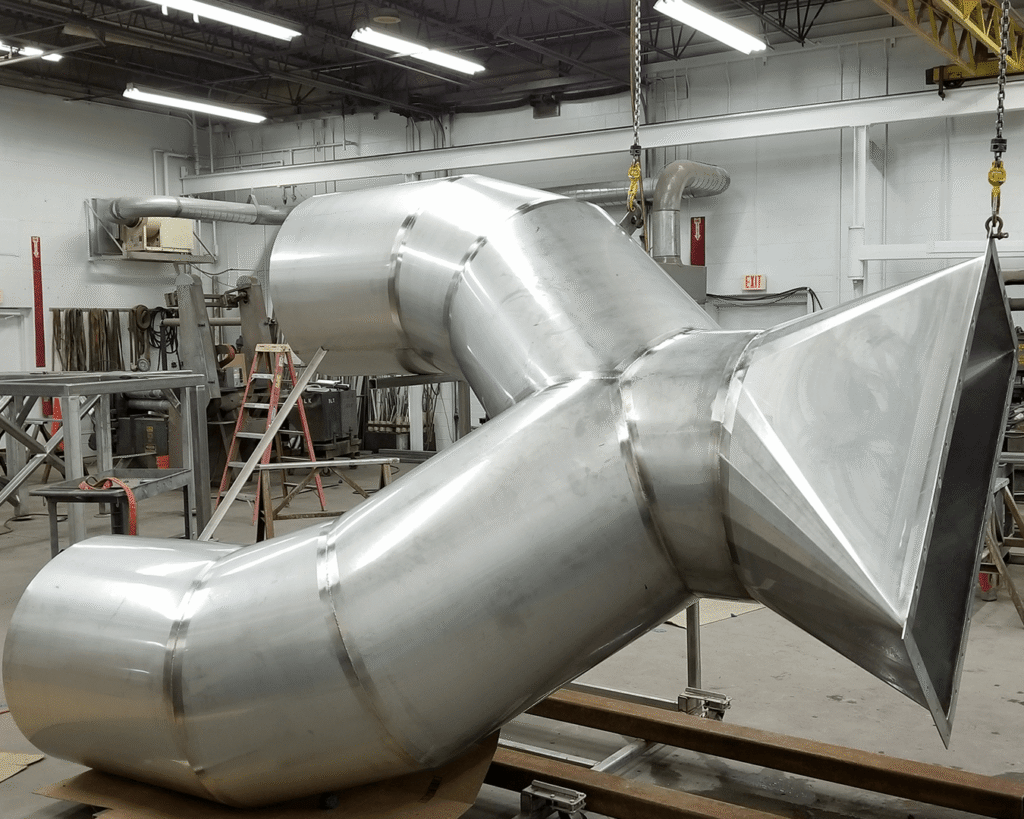
A fabrication-ready duct transition assembly, built directly from a coordinated BIM model.
What Is BIM-Driven Prefabrication?
BIM-Driven Prefabrication uses high-accuracy BIM models to manufacture HVAC components offsite before they ever reach the job site.
This includes prefabrication of:
- Duct mains and branch runs
- CHW/HW piping
- Condensate and refrigerant piping
- VAV/FPB box assemblies
- Mechanical room piping skids
- Multi-trade corridor racks
- Equipment connections and drops
Instead of cutting, welding, and assembling in the field, contractors receive ready-to-install assemblies built directly from coordinated BIM models.
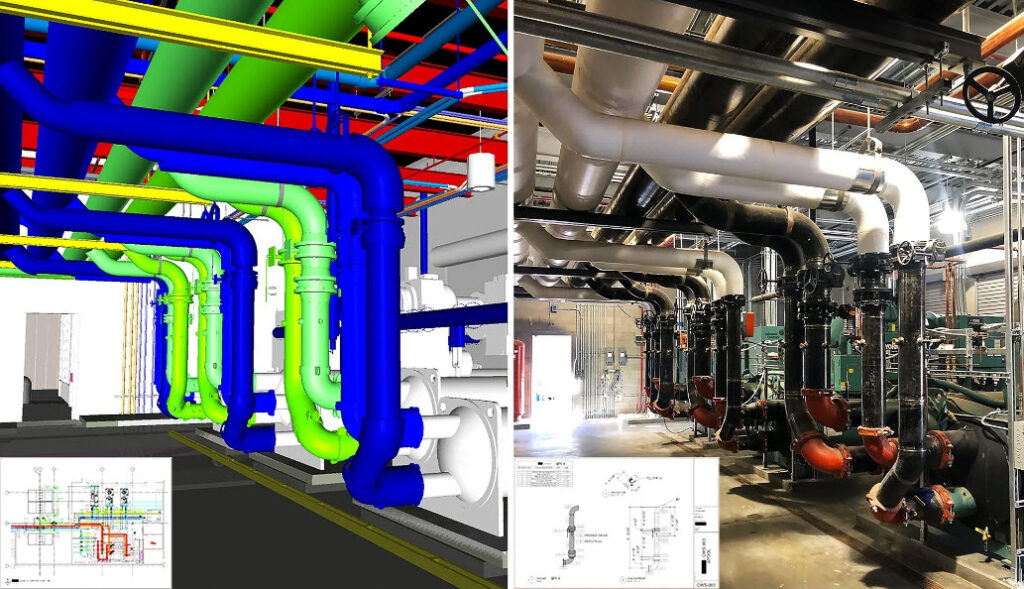
Modeled vs. installed: a chiller plant piping assembly shown in BIM (left) and as built in the field (right).
Why BIM Matters for Industrial Projects
Industrial facilities — manufacturing plants, energy facilities, pharmaceutical plants, warehouses, and processing centers — contain dense mechanical systems with strict tolerances.
BIM for Industrial Projects enables:
- Full 3D visualization of mechanical systems
- Early detection of clashes and access issues
- Optimized equipment placement
- Accurate routing of large-diameter duct and pipe systems
- Improved material planning and procurement
- Better sequencing and installation planning
Industrial clients demand precision. BIM ensures the mechanical systems are buildable, maintainable, and compliant before fabrication begins.
Improving Commercial HVAC System Design with BIM
Commercial buildings — hospitals, schools, office buildings, retail centers, and mixed-use developments — require HVAC systems that balance comfort, efficiency, and maintainability.
BIM for Commercial HVAC Systems provides:
- Accurate duct and pipe routing
- Equipment layout optimization
- Coordination with structural, electrical, and plumbing systems
- Reduced installation errors
- Better airflow and performance analysis
- Easier long-term maintenance planning
BIM ensures the HVAC system is fully coordinated and field-ready before construction starts.
The Role of HVAC Coordination Drawings in Prefabrication
Prefabrication is only successful when the underlying BIM model is fully coordinated.
HVAC Coordination Drawings provide:
- Clash-free routing
- Verified elevations and dimensions
- Access clearances for equipment
- Sleeve and penetration locations
- Hanger and support layouts
- Constructible installation drawings
These drawings ensure that prefabricated assemblies fit the first time — eliminating costly field modifications.
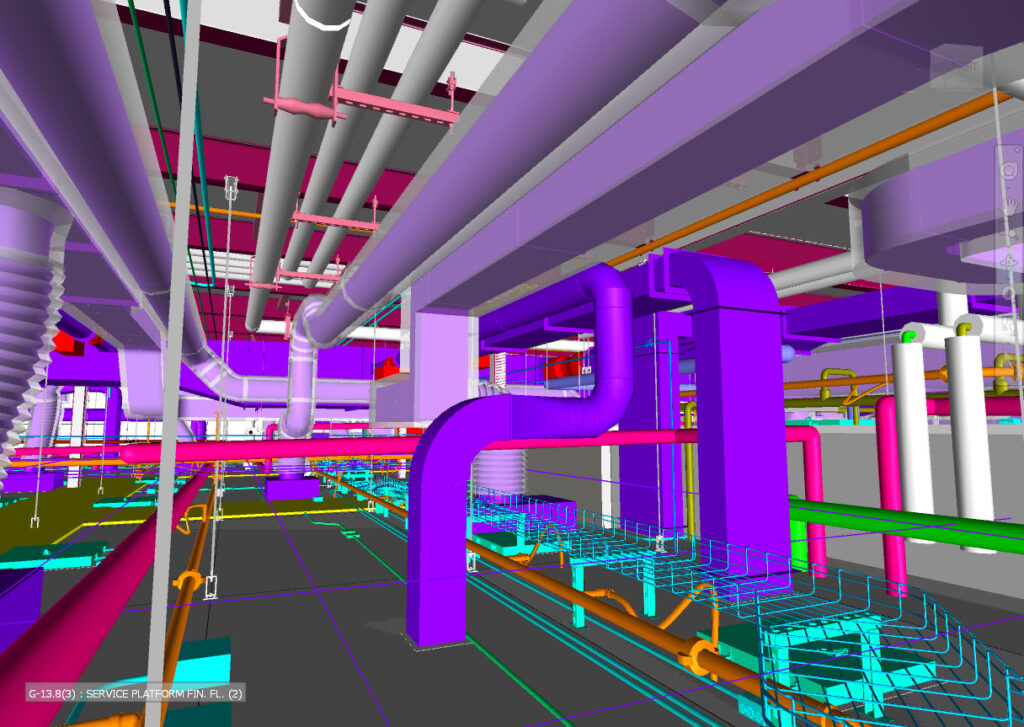
Clash-free, multi-trade coordination above a congested ceiling space — the foundation that makes prefabrication possible.
Technical Depth: What BIM-Driven Prefabrication Really Includes
To deliver contractor-grade prefabrication, AET develops BIM models at LOD 350–400, including:
1. Fabrication-Ready Spool Drawings
- Pipe spools with weld locations
- Duct sections with seam details
- Valve assemblies and specialties
- Hanger spacing and rod lengths
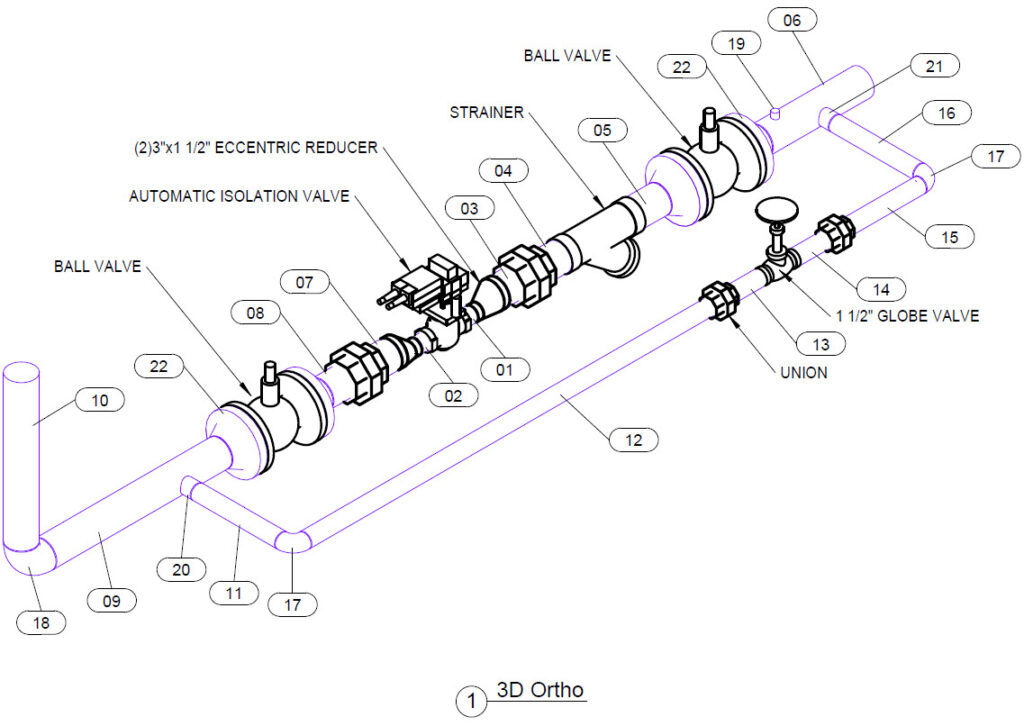
A fabrication-ready isometric spool drawing with fully dimensioned, numbered components.
2. Multi-Trade Corridor Racks
Coordinated racks including:
- HVAC ductwork
- CHW/HW piping
- Electrical conduits
- Plumbing mains
- Fire protection piping
3. Mechanical Room Prefabrication
- Pump skids
- Heat exchanger assemblies
- Boiler piping modules
- AHU connection assemblies
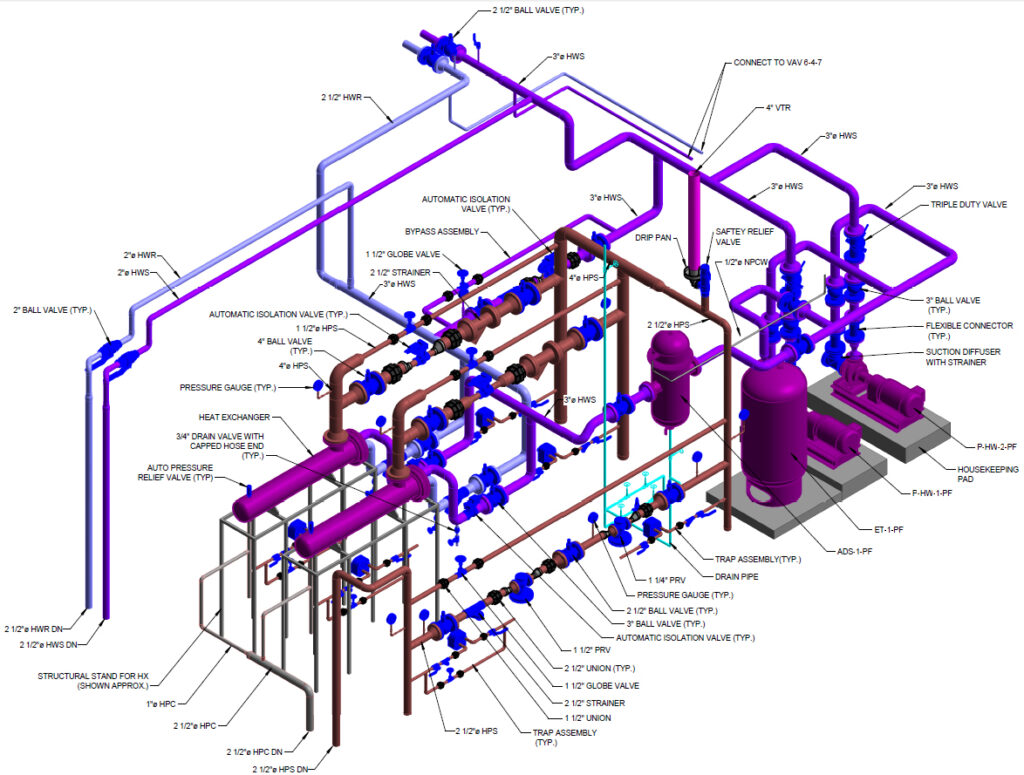
A coordinated mechanical room piping model — ready for skid fabrication and field installation.
4. Tolerances & Field Verification
- Laser scanning for as-built accuracy
- Total station layout for hanger points
- 1/8”–1/4” fabrication tolerances
- Verified elevations and offsets
5. BIM-to-Fabrication Integration
AET supports workflows such as:
- Revit → Fabrication CADmep
- Revit → CAMduct
- Revit → Pipe fabrication software
- Export to CNC plasma tables and coil lines
This is the level of detail required for true prefabrication, not just modeling.
How BIM-Driven Prefabrication Reduces Costs
Contractors benefit from:
1. Reduced On-Site Labor
Less cutting, welding, and assembly in the field.
2. Faster Installation
Assemblies arrive ready to install, reducing schedule duration.
3. Improved Quality Control
Fabrication shops provide controlled environments with consistent QA/QC.
4. Lower Material Waste
Exact quantities are generated from the BIM model.
5. Enhanced Worker Safety
Less overhead work, fewer hot-work operations, and reduced congestion.
6. Predictable Project Timelines
Fewer surprises mean fewer delays.
Why Contractors Choose Advantage Engineering Technologies
AET is a PE-led, BIM-driven MEP engineering firm providing end-to-end BIM solutions that support every phase of industrial and commercial HVAC projects, for mechanical and plumbing contractors across the U.S. and Canada:
- BIM-Driven Prefabrication
- HVAC Coordination Drawings
- HVAC BIM Modeling
- HVAC Shop Drawings
- HVAC As-Built Modeling
Our engineering-driven approach ensures accuracy, constructibility, and contractor-focused results on every project.
Conclusion
BIM-Driven Prefabrication is reshaping how industrial and commercial HVAC systems are designed, fabricated, and installed. By combining advanced BIM modeling with precise coordination and offsite fabrication, contractors can:
- Reduce costs
- Minimize rework
- Improve installation speed
- Enhance safety
- Deliver higher-quality buildings
Partnering with Advantage Engineering Technologies gives project teams the BIM expertise needed for accurate, efficient, and predictable project delivery.
Call to Action (Contractor-Focused)
Ready to streamline your HVAC installation with BIM-Driven Prefabrication and coordinated, fabrication-ready models? Contact Advantage Engineering Technologies today to support your next industrial or commercial project.